Your first surf camp
If this is your first surf camp, you probably have two thoughts at the same time:
-
“This looks sick.”
-
“There’s no way I’ll stand up.”
Both are normal.
Let me paint you a picture on what exactly to expect from this first surf camp week.
The “standing up” part is more realistic than you think
So far, everyone who’s been here for their first week eventually stood up on the board. Was it necessarily flashy? Nope.
We’ve had people from 18 up to 63, all surfing for the first time. Different bodies, different fitness levels, different levels of confidence.
That doesn’t mean it’s guaranteed for every single person in every situation. Surfing is still surfing. Conditions matter. Timing matters. Some days are easier than others.
But it does mean this: if you’re thinking you might be the one exception, you’re probably not.
Most people are capable. They just don’t know it yet.
You don’t need to be “super fit”
A lot of people think surfing requires a crazy level of fitness.
It doesn’t.
You don’t need to run marathons or lift heavy weights. A basic level of body control is enough. If you can hold a plank, move from lying down to standing, and keep yourself relatively stable, you’re fine.
Surfing in the beginning is much more about coordination and repetition than raw strength.
Paddling can be tiring, yes. But technique improves quickly, and sessions are structured so you don’t just burn yourself out. Most beginners don’t struggle because they’re weak. They struggle because everything is new at once.
That settles faster than people expect.
Balance sports help — but they’re not required
If you’ve done things like skating, snowboarding, skiing, slacklining, wakeboarding, windsurfing — that usually helps.
Not because you’re “better,” but because your body already understands balance and instability.
Being comfortable in the water helps too. Feeling how the ocean moves. Staying calm when things don’t go exactly as planned.
But even if you’ve done none of that: as long as you can swim, you’ll be fine. It might take a bit longer to feel comfortable on the board, but that’s not a problem. Surfing doesn’t reward rushing.
Your first board will feel big
Beginners start on big boards for a reason.
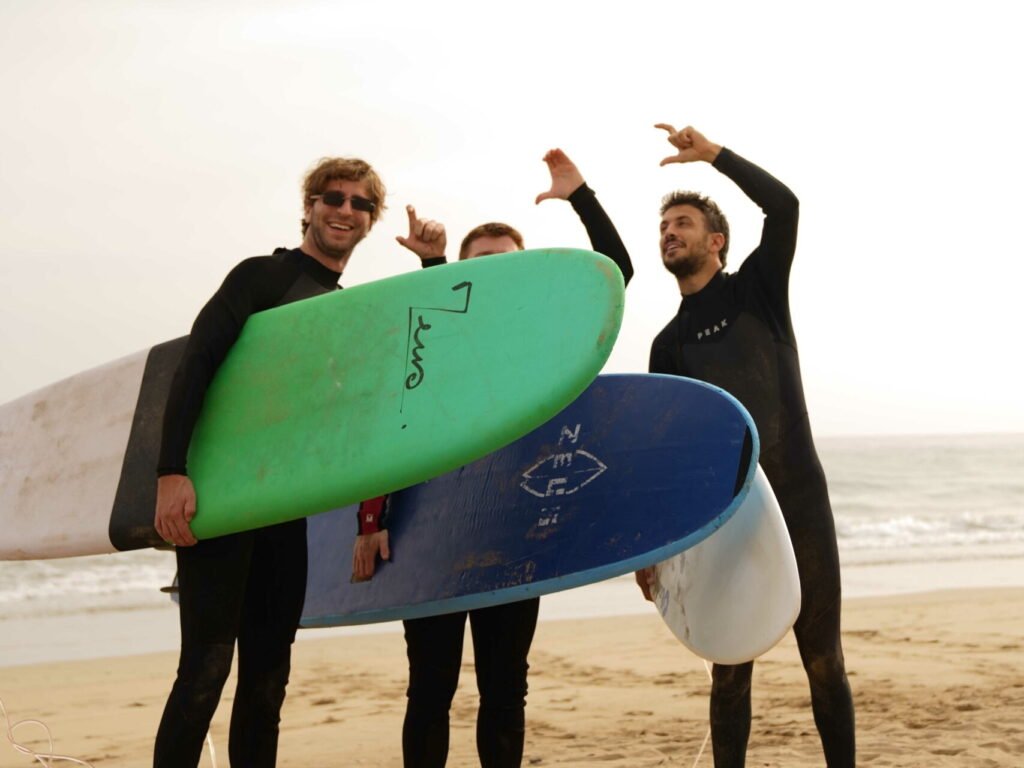
Most people begin on something around 8’0, with a lot of volume. These boards are stable, float easily, and forgive mistakes. They catch waves early and give you time.
They don’t look cool.
They work.
A bigger board means:
-
easier paddling
-
easier wave entry
-
more time to stand up
-
less punishment for doing things wrong
That’s what you want in the beginning.
Most of the first week happens in whitewater
This is where expectations often need adjusting.
In your first week, you’ll mostly surf whitewater – the broken part of the wave.
You won’t be cruising down clean green waves. You won’t be turning much. You’ll mostly be going straight.
And that’s exactly the point.
Whitewater gives you speed. It lets you focus on popping up, staying stable, and understanding what a wave actually feels like under your feet.
From the beach it might look simple. In the water, it teaches you almost everything you need for later.
Green waves come later - sometimes sooner, sometimes not
Some people start trying green waves in their first week. Sometimes it works. Sometimes it doesn’t.
Going sideways adds new variables: positioning, timing, angle, reading the wave. Those things come naturally once the basics are there.
If you leave your first week being able to:
-
pop up consistently
-
paddle with control
-
understand where to be in the water
-
fall without panicking
You’ve made all the progress you need.
About safety
Surfing is an ocean sport. There are risks.
Beach breaks can be shallow. Reef breaks exist. You can get pushed into the sand. Wipeouts happen.
But most beginner injuries don’t come from dramatic situations. They come from small mistakes:
-
diving headfirst
-
holding onto the board when you shouldn’t
-
not paying attention to others
Good instruction and awareness reduce those risks a lot. Learning how to fall and how to behave in the water matters more than strength or courage.
If you have joint issues, say it early
If you have loose shoulders, unstable knees, hypermobility, or anything similar, that doesn’t automatically mean surfing is a bad idea.
It just means we want to know.
Surfing is repetitive. Problems usually come from repetition with bad mechanics, not from one big moment. With the right approach, most people can still surf safely.
The honest expectation
Your first week surfing will probably be:
-
repetitive
-
tiring in a new way
-
frustrating at times
-
surprisingly fun
You’ll fall a lot.
You’ll laugh at yourself.
You’ll have moments where things suddenly click.
Standing up is very realistic.
Becoming a great surfer in one week is not.
And that’s fine.
What matters is whether you enjoy the process enough to come back the next day.
If you do, the rest follows.