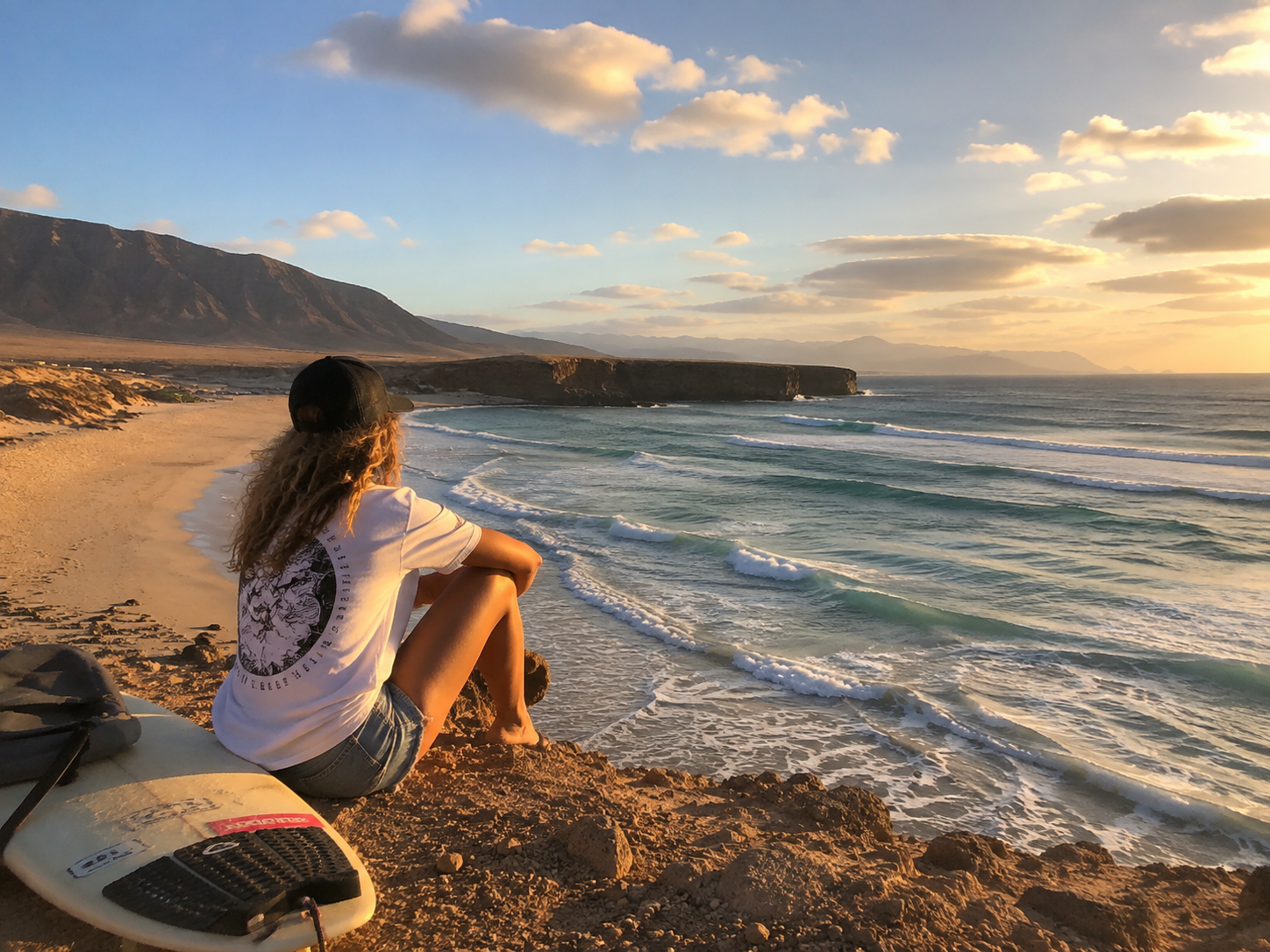
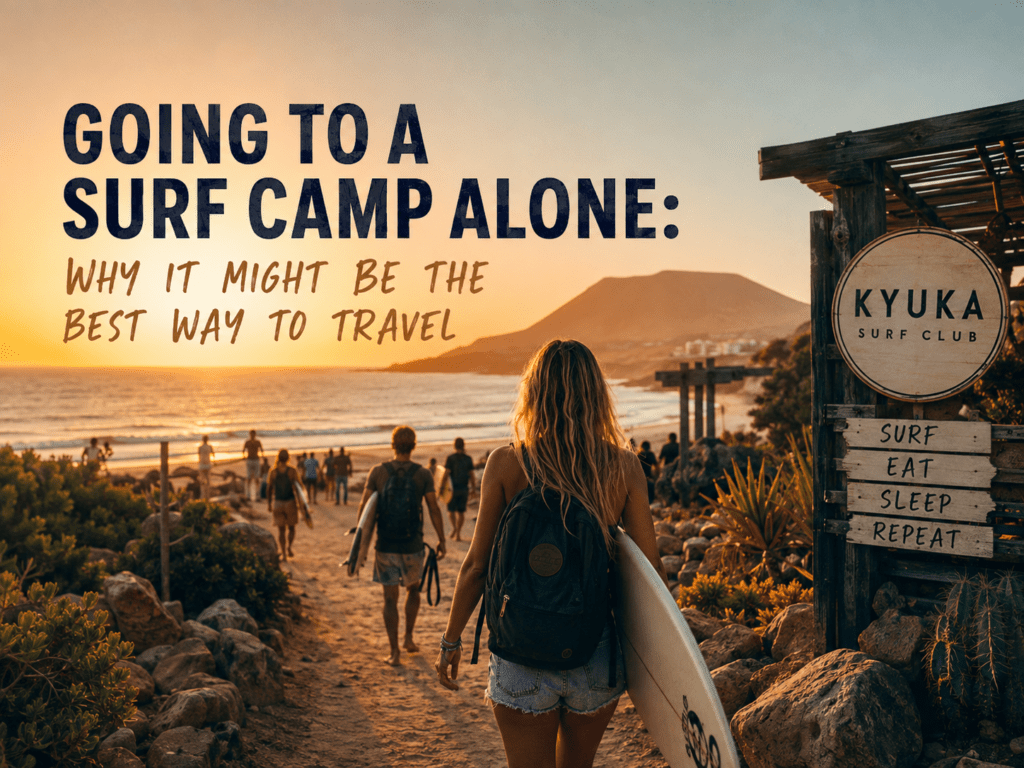
Going on holiday alone always sounds great when you’re thinking about it from home. You can choose exactly where you want to go, make your own plans and never have to spend half an hour discussing where everyone wants to eat. Then you actually start looking at flights and accommodation, and suddenly the whole idea feels a little more serious. Who will I talk to when I get there? What if everyone else arrives with friends? What if I’m terrible at surfing? And what exactly am I supposed to do at dinner if I don’t know anyone?
If you’re thinking about going to a surf camp alone, questions like these are completely normal. Travelling somewhere new by yourself already takes you outside your usual routine, and combining that with learning to surf can make the whole thing feel like quite a big step. But that’s also exactly why a surf camp works so well for solo travel. Instead of arriving somewhere and having to figure everything out by yourself, you immediately become part of a group of people who have come for more or less the same reason: to surf, spend time outside, experience somewhere new and hopefully meet some good people along the way.
Is It Normal to Go to a Surf Camp Alone?
Going to a surf camp alone is much more normal than you might imagine before your first trip, and it’s a completely different experience from simply booking a hotel by yourself. In a hotel, you can spend a week surrounded by hundreds of people without having a proper conversation with any of them. At a surf camp, your days naturally overlap with everyone else’s. You wake up in the same place, head to the beach together, surf together and come back with stories from the same session. By the time you’re sitting around the table later, you already have something to talk about.
That’s one of the reasons a surf camp can work particularly well for solo travellers. You don’t have to force yourself into random conversations because the experience itself creates them. Someone asks where you’re from, you ask whether they’ve surfed before, and before long you’re talking about the wave you both completely failed to catch that morning. Those small interactions make arriving alone feel much less intimidating than it might have seemed when you were booking the trip.
The people around you will usually have very different reasons for being there. Some are taking a break from work, some are travelling for a few weeks, some have wanted to learn to surf for years and others simply wanted to escape their normal routine for a while. You don’t necessarily have much in common on paper, but once you’re sharing surf sessions, meals and days around the island, that tends to matter a lot less.
You Don't Need to Arrive as a Surfer
For many people, the nervousness before a solo surf trip isn’t only about travelling alone. There’s also the fear of arriving and discovering that everyone else somehow already knows what they’re doing. It’s easy to picture a camp full of experienced surfers effortlessly riding waves while you’re still trying to understand how you’re supposed to carry the board without hitting someone with it.
In reality, people arrive with all kinds of experience. Some have never touched a surfboard before, some have taken a few lessons on previous holidays and others have been surfing for years. If you’re completely new, Fuerteventura can be a great place to start, and our guide to beginner surfing in Fuerteventura explains what beginners can expect in more detail.
Your first week isn’t about becoming an amazing surfer anyway. It’s about getting comfortable in the water, understanding the basics and gradually noticing that things which felt impossible at the beginning of the week are becoming slightly easier. There will be falls, missed waves and probably a fair amount of seawater swallowed along the way, but there will also be those moments when something finally works. A wave that looks tiny from the beach can feel enormous when it’s the first one you’ve actually managed to ride.
Progress also looks different for everyone, so comparing yourself to the person on the board next to you doesn’t make much sense. If you’re curious about what learning actually looks like over several days, we’ve written more about what you can expect from your first week surfing.
Why Meeting People Feels More Natural at a Surf Camp
One of the most common worries about travelling alone is making friends. People often say, “Just go and talk to someone,” which is technically good advice but not particularly useful when you’re standing in a room full of strangers wondering what you’re supposed to say.
The nice thing about a surf camp is that you don’t have to manufacture reasons to talk to people because you’re already doing things together. You drive to the surf spot, get ready on the beach, paddle out, watch each other catch waves and inevitably see a few spectacular wipeouts. Afterwards, there’s always something to talk about because you’ve just shared the same experience. A conversation that starts with asking someone how their surf session went can easily turn into making plans for the afternoon or sitting around talking until much later than expected.
We’ve written before about why making friends as an adult can feel weirdly hard, and travel has an interesting way of making some of that awkwardness disappear. At home, most people already have routines, friendship groups and places they need to be. When travelling, those structures temporarily disappear. People have more time, they’re usually more open to conversation and many of them are hoping to meet someone new too.
That doesn’t mean you need to become incredibly outgoing the moment you arrive. If you’re naturally quieter, you don’t have to suddenly turn into the loudest person at the table. Most friendships at a surf camp aren’t created through huge social moments anyway. They grow through breakfast conversations, drives to the beach, sitting around after surfing or asking someone if they want to grab a coffee. Being interested in the people around you often matters much more than being entertaining, which is something we also explore in our article about how to connect with your surf camp group.
And if you occasionally want some time to yourself, that’s completely fine. Travelling solo doesn’t mean you have to spend every waking minute being social. In fact, one of the best things about it is being able to move between the two. You can spend the morning surfing with everyone, have lunch with the group and then disappear for a quiet coffee or an afternoon on your own without having to explain your plans to anyone.
The Freedom of Travelling Alone
That freedom is probably one of the most underrated parts of taking a solo surf trip. When you’re travelling with friends, even simple days involve a surprising amount of negotiation. One person wants to go to the beach, another wants food, someone else isn’t ready yet, and somehow a group of adults can spend 45 minutes discussing plans without actually leaving the house.
When you’re on your own, your time belongs to you. If you want to stay at the beach after surfing, you can. If you feel like sitting somewhere with a coffee for an hour, there’s nobody waiting for you. If people from the camp are heading out for dinner and you want to join them, great. If you’re exhausted after surfing and would rather go to bed early, that’s equally fine. You can follow your own energy instead of constantly adjusting to somebody else’s schedule.
Strangely, that independence can actually make the trip more social rather than less. When you travel with friends, it’s easy to remain inside the group you already know. You have people to sit with, eat with and explore with, so there isn’t much reason to step outside that comfortable little circle. When you arrive alone, you’re naturally more open to the people around you, and the people around you are often in exactly the same situation.
Why Fuerteventura Works So Well for a Solo Surf Trip
Fuerteventura fits this kind of travel particularly well because surfing and outdoor life are such a big part of the island, especially in the north around Lajares, Corralejo and El Cotillo. People come here from all over Europe and beyond to surf, spend time outside, work remotely or simply slow life down for a while. That mixture of locals, travellers and surfers means meeting someone who arrived on the island alone isn’t unusual at all.
Kyuka is based in Lajares, a small village in northern Fuerteventura surrounded by volcanic landscapes and within easy reach of different surf areas. It has enough going on that you can find cafés, restaurants, markets and places to spend an evening, while still being small enough that after a few days you start recognising the same faces. If you’re curious about what there is to do away from the water, our local guide to Lajares gives you a much better picture of the area.
The north and south of Fuerteventura offer quite different holiday experiences, so it’s worth choosing based on the type of trip you want rather than simply looking for the closest beach. We’ve compared the two in our guide to north vs south Fuerteventura, but if surfing, meeting people and having a more active trip are high on your list, the north is well worth considering.
Life here also tends to follow the conditions rather than a perfectly fixed schedule. Surf sessions depend on factors such as swell, wind, tides and the experience of the group, so you gradually get used to allowing the ocean to decide part of your day. Once the surf is finished, the afternoon might mean relaxing at the camp, exploring the island, getting some food or heading somewhere with the people you’ve met. Some days are busy and others are slow, and after a while that starts to feel completely normal.
Conditions change throughout the year too, so there isn’t one perfect month that suits everyone. If you’re deciding when to plan your solo surf trip, our month-by-month guide to the best time to surf in Fuerteventura explains what the different seasons can bring.
Shared Room or Private Room?
If you’re travelling alone, choosing between a shared and private room can shape the experience more than you might expect. A shared room naturally puts you around other people from the moment you arrive, which can make those first introductions easier and often suits travellers who want the social side of camp life. A private room, on the other hand, gives you somewhere to retreat when you’ve had enough activity for the day and want a little space.
Neither choice means you’ll have a more or less social trip. It’s really about how much privacy you like and how you normally recharge. You can stay in a private room and spend almost all your time with the group, just as you can stay in a shared room and still take time for yourself during the day. If you’re not sure which sounds more like you, our guide to choosing a shared or private room at a surf camp goes into both options in more detail.
Packing for the trip can be kept fairly simple too. Fuerteventura is casual, and if most of your days involve surfing, beaches and hanging around the island, there’s not much reason to bring your entire wardrobe. Pack the things you’ll actually use, leave some space in the bag and accept that nobody is going to care if you’ve worn the same T-shirt more than once. For the practical side of preparing, we’ve put together a full guide on what to pack for a surf camp in Fuerteventura.
The Hardest Part Often Happens Before You Arrive
The strange thing about travelling alone is how good your brain becomes at inventing situations before they’ve happened. You imagine not meeting anyone, feeling awkward at dinner, being the worst surfer in the group or discovering that everyone else is somehow completely different from you. Because you’re sitting at home thinking about a place you’ve never been and people you’ve never met, there’s nothing there to prove those thoughts wrong.
Then you arrive and reality tends to be much simpler. Someone asks where you’re from. You learn a few names. You go surfing together. Maybe you grab something to eat afterwards. By the second or third day, you already have people to sit next to at breakfast and someone asking what you’re doing later. The situation you spent weeks thinking about starts to feel surprisingly ordinary.
That’s one of the things solo travel can teach you. The anticipation is often more uncomfortable than the experience itself. We’ve explored that feeling before in the story of a first solo surf trip, because getting on the plane alone can end up changing much more than where you spend your holiday.
You don’t need to convince a group of friends to come with you, and you don’t need to wait until somebody else’s holidays line up with yours. You also don’t need to arrive as a surfer or as the kind of person who can walk into a room and immediately talk to everyone. You can simply arrive as you are and let the week develop from there.
Maybe you’ll leave Fuerteventura having learned how to surf a little better. Maybe you’ll leave with a few new friends, a group chat that somehow never stops or plans to meet someone again in another country. Most likely, you’ll leave with a mixture of all of it.
And somewhere between arriving alone on the first day and saying goodbye at the end of the week, you might realise that going to a surf camp alone never really meant spending the week alone in the first place.