
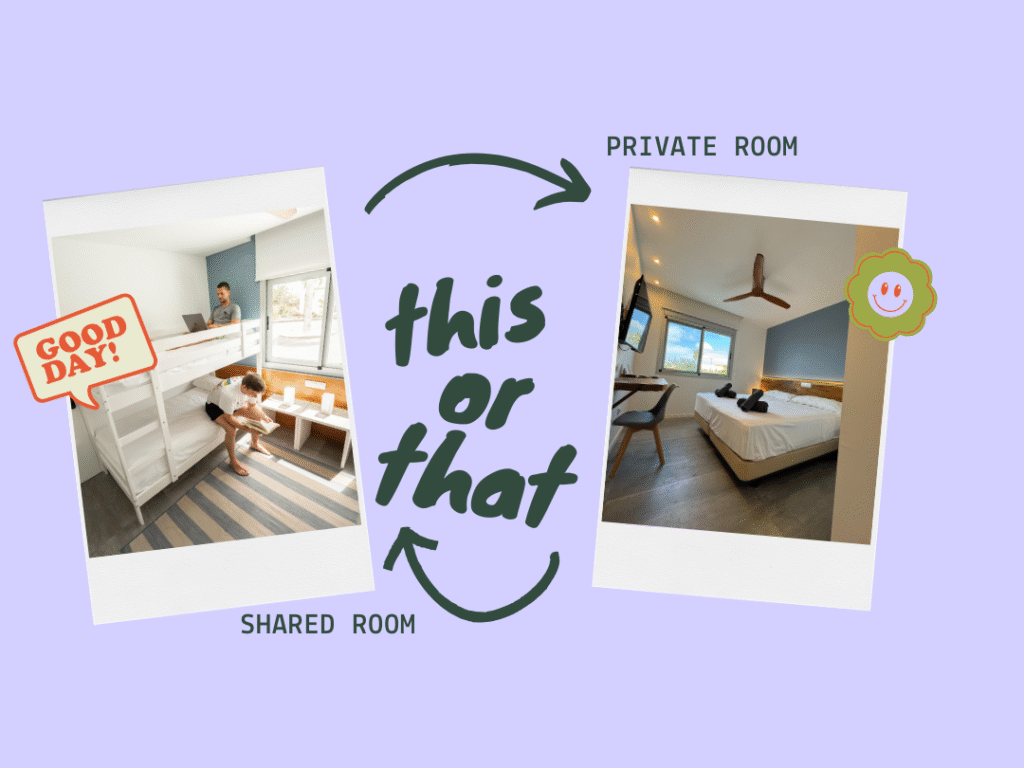
Do you have a private room?
This is usually one of the first questions people ask us. Not necessarily about the surfing or even the island, but about where they’re going to sleep.
“I’m not sure if I should book a shared room or a private one.”
What’s interesting is how early this question comes up. Sometimes people are thinking about it before they’ve booked their flights or even really know what kind of surf camp they’re joining. On the surface, it sounds like a simple decision about comfort, but usually there’s a little more behind it.
It’s about how much space you need, how comfortable you are being around new people and how much interaction you actually want during the week. Most people don’t have a clear answer straight away, especially if it’s their first time staying at a surf camp.
Why people choose a surf camp in the first place
If all you wanted to do was surf, there would be easier ways to organise the trip. You could book an Airbnb, take a few surf lessons and spend the rest of your time doing whatever you want. You could decide exactly when you want to be around people and when you’d rather be alone. From a purely practical point of view, that might even be the simpler option.
But most people don’t choose a surf camp because it’s simply the most efficient way to go surfing. They choose it because they want something around the surfing as well, and very often that something is other people.
Shared meals, familiar faces throughout the week and having people around to explore the island with can completely change the experience. Even people who describe themselves as “not very social” usually still want some kind of human connection. It doesn’t have to mean being around people constantly. It can simply mean having someone to eat breakfast with, talk about the morning surf or head into town with later.
That social side is also one of the reasons a surf camp can work so well for solo travelers. You arrive on your own, but you don’t have to build a social circle from scratch once you get there. The camp already creates a framework for people to meet naturally, and the room you choose can play a bigger part in that than you might expect.
The private room
A private room often feels like the safer option because you know you’ll always have somewhere to retreat to. You have your own space, your own rhythm and a door you can close when the day has been full enough. For people coming from a busy job, a stressful period at home or simply someone who really values having time alone, that can make a huge difference.
There’s absolutely nothing wrong with choosing that. A surf camp is still your holiday, and getting enough rest matters when your days involve surfing, activities and spending time with a group of people you’ve only just met.
At the same time, having your own room does make it easier to retreat. You might skip small moments without really noticing, not because you don’t want to connect with the group, but simply because you always have the option of going back to your own space.
That isn’t necessarily a disadvantage. It just creates a slightly different experience, with a little more separation and more control over how much time you spend around everyone else. For some guests, that balance is exactly what makes the week enjoyable.
Why shared rooms create something different
Most people hesitate at least a little before booking a shared room, especially when they’re travelling alone. They wonder who they’ll be sharing with, whether everyone will get along and whether they’ll have enough space to themselves after a long day.
Those are completely reasonable questions. Interestingly, the people who think about these things beforehand are often the easiest people to share a room with because they’re already conscious of the fact that they’ll be sharing a space with someone else.
Once you’re actually there, the social side tends to happen without much effort. You talk because you’re in the same room. You laugh about something stupid that happened during the surf lesson. You get ready for dinner at the same time, or you’re both completely exhausted and barely say anything at all.
None of that needs to be planned. It’s simply what happens when people share a space, and during the first few days of a surf camp those small interactions can make getting comfortable with the group much easier. If the social side is something you’re worried about, our article on why you maybe shouldn’t join a surf camp talks more about some of the doubts people have before coming.
Friction and why it helps
A shared room naturally comes with a little more friction. You can’t completely disappear whenever you want, and you have to be aware that another person is using the same space. You say good morning, exchange a few words while getting ready and usually end up hearing about how the other person’s day went without anyone having to organise a conversation.
Normally we think of friction as something to avoid, but in a surf camp it can actually make connecting with people easier. Those tiny interactions lower the barrier between being the new person who just arrived and actually feeling like you’re part of the group.
This can be especially helpful if you’re naturally shy or take a little longer to open up around new people. You don’t have to suddenly become extremely social or force yourself into conversations. You’re simply around the same people often enough that talking to them gradually becomes normal.
In that sense, going slightly outside your comfort zone can sometimes make the social part easier rather than harder.
What this choice is really about
Most people think they’re choosing between two different levels of comfort, but the real decision is usually about how much closeness and unplanned interaction they want during the week.
A private room gives you more control, clearer boundaries and somewhere that is completely yours. A shared room gives you more proximity to other guests and makes it easier for small interactions to happen naturally throughout the day.
Neither option automatically gives you a better surf camp experience. Someone in a private room can become one of the most social people in the group, while someone staying in a shared room might still prefer spending plenty of time alone.
The room doesn’t determine your week, but it does influence the environment you create for yourself.
How we see it at Kyuka
We’ve seen people staying in private rooms become incredibly close with the rest of the group, and we’ve also had people in shared rooms who preferred keeping mostly to themselves. So the room definitely doesn’t decide everything.
Still, when someone tells us they’re nervous about booking a shared room but part of them is also curious about it, that usually says quite a lot. Often they want the social experience but aren’t completely sure how comfortable they’ll feel once they arrive.
The shared room simply removes a few of the steps involved in meeting people. Instead of having to actively seek out interaction, you naturally start getting to know the people around you.
That can be particularly useful during the first couple of days, when everyone is still finding their place in the group. What feels unfamiliar on the first evening can feel completely normal surprisingly quickly.
If you’re trying to decide
Instead of asking which room is objectively better, think about what you actually need from this particular trip.
If you’ve had a busy few months and know that having somewhere quiet to recharge will make the rest of your holiday more enjoyable, a private room might be worth it. If you’re travelling alone and one of the main reasons you chose a surf camp is to meet people, sharing a room can make that part of the experience happen more naturally.
You can also think practically about what the rest of your week will look like. Your days will probably involve surf sessions, meals, activities and plenty of time outside the room anyway, so it helps to think about what you want your accommodation to give you when you finally come back at the end of the day. If you’re still planning the practical side of the trip, our surf camp packing guide for Fuerteventura can help with that part.
Both choices are completely valid. The important thing is to choose based on the experience you actually want, rather than automatically picking the option that feels safest before you arrive.
If part of you wants the shared-room experience but you’re only avoiding it because it feels unfamiliar, it might be worth giving it a chance. Sometimes the part you’re slightly nervous about ends up being one of the best parts of the trip.